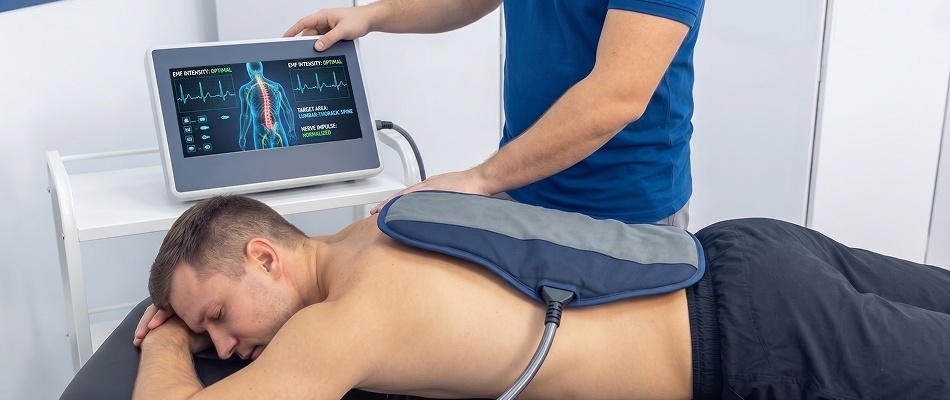
Imagine yourself at a clinic. A small pad is placed on your lower back. There is no injection, no incision, and no pinching of the skin. A device gently sends out painless, invisible pulses deep into your muscles. Moments later, you stand up; your muscles feel more relaxed, and over the next few sessions, the pain gradually eases.
Does it sound like science fiction? Actually, it isn’t.
It is called Nerve Reactivation Therapy (NRT), an advanced, non-invasive treatment that uses precision-controlled electromagnetic stimulation to activate nerves, muscles, and deep tissues. Quietly gaining popularity in pain management and rehabilitation, NRT offers a modern, technology-driven approach without surgery, medication, or downtime.
If you have experienced chronic back pain, painful knees for several weeks, muscle weakness, or sciatica, here’s what you need to know.
What is Nerve Reactivation Therapy?
Nerve Reactivation Therapy (NRT) is an advanced therapeutic technology that uses controlled electromagnetic fields to stimulate nerves, muscles, and tissues deep within the body. The therapy is completely non-invasive, meaning there are no injections, no surgery, and no recovery period afterward.
By activating the body's neuromuscular system, NRT helps relieve pain, improve muscle function, enhance blood circulation, and support tissue healing. Today, it is increasingly used alongside physiotherapy and rehabilitation to manage a wide range of musculoskeletal and neurological conditions.
How does it actually work?
Here's the part that surprises most people: NRT works through the skin, without breaking it.
Think of it as a four-step relay race happening inside your body:
1. A device generates controlled electromagnetic pulses.
2. These pulses pass straight through the skin without causing any surface damage.
3. The pulses stimulate the nerves or muscles underneath, causing them to activate and contract.
4. This activation helps improve blood flow, restore muscle function, reduce pain, and support healing over repeated sessions.
A simple way to picture it: when NRT is applied to the back muscles, the electromagnetic pulses cause those muscles to contract and relax, almost like a guided workout. Except that instead of you doing the exercise, the technology safely does the "exercise" for you.
A closer look
NRT for spinal problems
“Picture a patient in their early forties with a herniated disc pressing against a spinal nerve. That pressure causes inflammation and pain that radiates straight down the leg - the unmistakable burning sensation of sciatica.
During a typical NRT session, an electromagnetic applicator is placed over the lower back or affected spinal area. The device sends controlled pulses for about 15-30 minutes. Most patients experience only gentle tapping sensations or mild muscle contractions, making the treatment comfortable,” explains Dr. Raghu, Founder Chairperson of Vital Village, Maharashtra's first AI and Robotic Healing Therapy hub.
Here's an important myth to bust first: NRT does not push a slipped disc back into its place. Meaning, it cannot physically reverse the structural problem. What it does do is calm the irritated nerve, reduce pain and inflammation around the spine, improve muscle function, and support healing during spinal rehabilitation.
“Spinal problems often cause the surrounding muscles to tighten or go into protective spasm, which further adds to the pain. NRT helps relax these tight muscles, improve flexibility, and reduce pressure on the affected spinal nerves. Combine that with improved blood circulation (more oxygen and nutrients reaching the injured area, waste products cleared out faster), and you get a treatment that supports healing from multiple angles,” adds Dr. Raghu.
NRT for knee pain caused by Osteoarthritis
Now imagine someone in their sixties living with knee osteoarthritis (OA). Climbing stairs has become difficult, and even simple everyday activities are often avoided because of persistent knee pain.
Osteoarthritis occurs when the protective cartilage cushioning the joints gradually wears down, causing the bones to rub against each other. This leads to pain, stiffness, swelling, and reduced mobility. In many cases, severe knee OA eventually leads people to consider knee replacement surgery.
While NRT cannot rebuild damaged cartilage, it can play an important role in managing osteoarthritis symptoms.
The therapy helps in muscle strengthening. By stimulating the muscles surrounding the knee, NRT helps strengthen the joint’s supporting structures, reducing pressure on the affected cartilage and improving stability.
Strengthening the thigh muscles, for example, reduces stress on the knee joint. This is why NRT is often recommended alongside physiotherapy, exercise, weight management, and other non-surgical treatment approaches.
How NRT supports healing at the cellular level
The benefits of NRT extend well beyond pain relief and muscle strengthening. Research suggests that controlled electromagnetic stimulation interacts with the body's natural electrical signals, encouraging several biological processes involved in tissue repair and recovery.
Here’s what happens inside your body during a session:
· Improved blood flow:
NRT enhances microcirculation, allowing more oxygen and nutrients to reach injured tissues, thereby facilitating faster and more effective healing.
· Increased cellular activity:
The therapy stimulates cellular metabolism, increases ATP (energy) production, and activates fibroblasts (cells involved in tissue repair and collagen formation).
· Support for bone healing:
NRT has also been shown to activate osteoblasts (cells that form bones) and improve bone mineralization, which is why a related technology, PEMF (Pulsed Electromagnetic Field therapy), is sometimes used in fracture healing and osteoarthritis management.
Key benefits of Nerve Reactivation Therapy
As a non-invasive treatment, NRT offers several advantages:
· Drug-free pain management
· No recovery downtime
· Improved muscle strength and activation
· Reduced inflammation
· Enhanced tissue healing
· Can complement physiotherapy and rehabilitation programs
The bigger picture
Like any medical treatment, Nerve Reactivation Therapy is not a miracle cure. It cannot regenerate cartilage, physically correct a slipped disc, or replace surgery when surgery is genuinely required.
However, as a non-invasive technology for reducing pain, controlling inflammation, improving circulation, activating muscles, and supporting the body's own repair mechanisms, NRT can be adapted to support rehabilitation for a variety of musculoskeletal and neurological conditions.
It's not meant to replace surgery, physiotherapy, or exercise. It's meant to complement them.